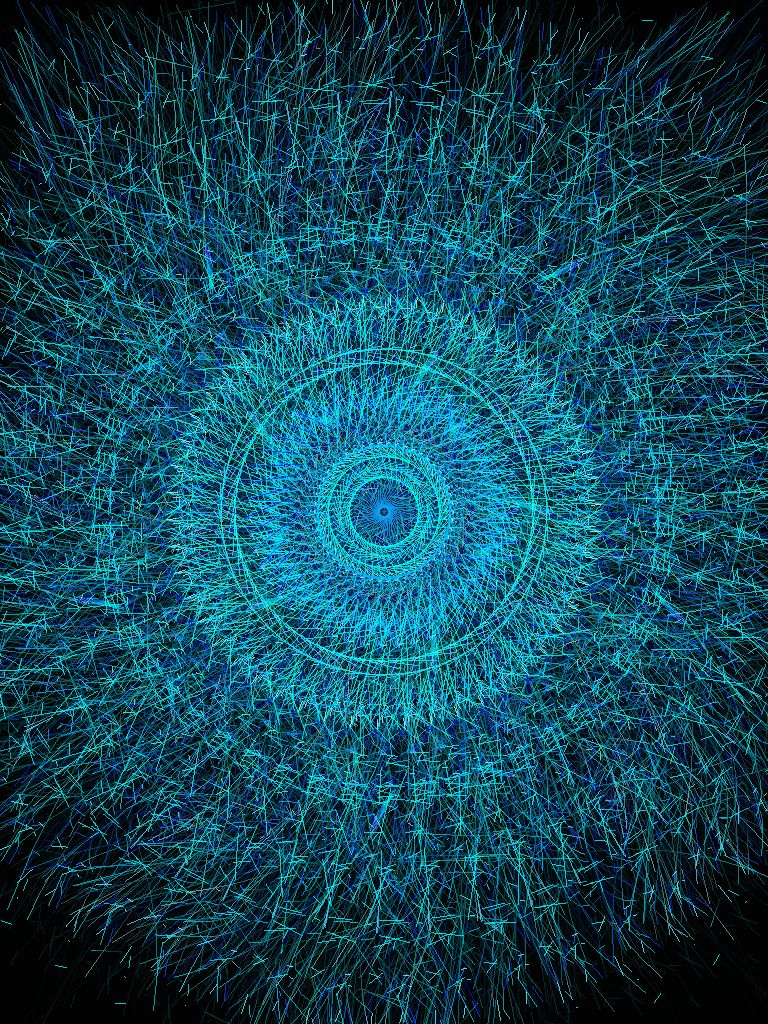
What is this gorgeous image, you ask? It’s a screenshot from an app called Uzu, available on the iTunes store. It’s only $1.99 and has already provided hours of enjoyment for me and anyone else that wanders by. It’s hard to describe how it works, so check out this video:
Here are a couple more images I’ve swirled into existence:
I’m almost finished with a picture book called SEEING SYMMETRY plus I bought an iPad 2 last month...that’s how I ended up with the Uzu app. By adjusting the controls, you can get the image to freeze when you take your fingers off the screen. It’s one of those apps you just have to get your hands on to see what it’s really like.
The images often have a textile-like quality... depending on the options you choose, they may consist of thin lines that look similar to thread. At other times there are little dots or wider strips that move, pulsate, explode, and otherwise dance along with your finger movements. Enjoy!
Showing posts with label inspiration. Show all posts
Monday, May 30, 2011
Wednesday, December 1, 2010
Inspired Ideas: The Christmas Issue
Inspired Ideas is an online ezine I just found out about via Elizabeth Dulemba’s blog. It has 168 pages plus an appendix... click here to check it out:
It’s full of creative and unusual craft projects such as a Christmas village made of recycled cereal boxes, a yarn ball wreath, cookie cutter jewelry designed by a gallery of crafters, artists, and bloggers including Mary Engelbreit. The brainchild of Amy Powers, it is an impressive example of innovative publishing... and it’s free!
Happy browsing!
Thursday, September 30, 2010
Tag Galaxy... a fabulous way to find images
Do you need reference photos and/or inspiration? The Tag Galaxy image search system has been around for a year or two, but I just heard about it. You enter a tag (i.e. search term) such as quilts and a solar system appears:
The main term quilt is on the Sun, while related terms such as fabric, sewing, and patchwork orbit around it. When you click on the Sun, images start flying in from all sides:
The images are photographs coming from Flicker that have been tagged with the word quilt, apparently. Once they have arranged themselves into a sphere...
you can rotate it up, down, and around to see the images on all sides. If you want to zoom in on one photo, just click on it...
...and it enlarges. The web site is animated with Flash, so this post gives just a hint of how cool it is. Try it and be mesmerized!
I almost forgot to mention where I heard about this, on the Teach Science and Math blog...many thanks to David Wetzel. There are several other image search engines mentioned in his post, so you may want to check those out, too.
The main term quilt is on the Sun, while related terms such as fabric, sewing, and patchwork orbit around it. When you click on the Sun, images start flying in from all sides:
The images are photographs coming from Flicker that have been tagged with the word quilt, apparently. Once they have arranged themselves into a sphere...
you can rotate it up, down, and around to see the images on all sides. If you want to zoom in on one photo, just click on it...
...and it enlarges. The web site is animated with Flash, so this post gives just a hint of how cool it is. Try it and be mesmerized!
I almost forgot to mention where I heard about this, on the Teach Science and Math blog...many thanks to David Wetzel. There are several other image search engines mentioned in his post, so you may want to check those out, too.
Sunday, June 20, 2010
Critter sighting
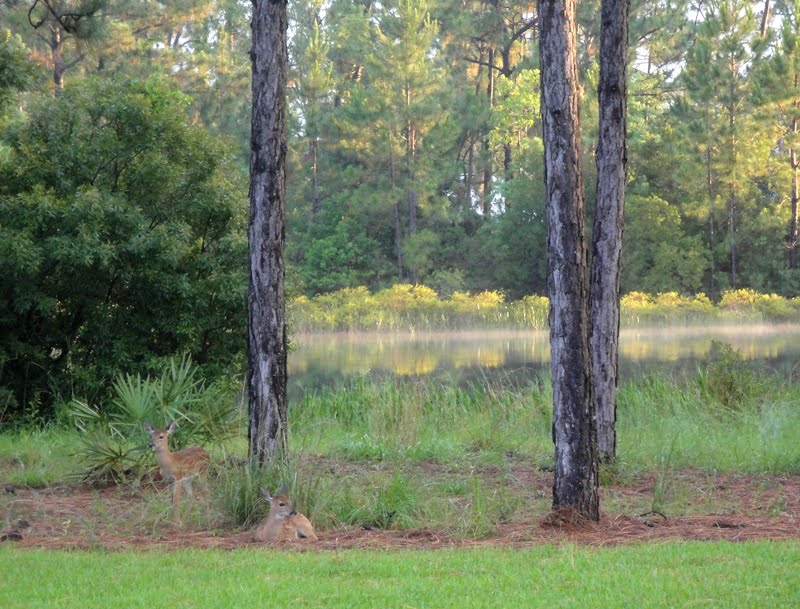
Hmmm, what is that in the backyard? A pushmi-pullyu?
Nope, just adorable twin fawns. They wandered around nibbling here and there (please, help yourself to the grape vines, guys!) I never did see a doe, although a buck with velvet-encased antlers ate his way along the side of the house. The twins settled down near the pond as twilight came. I assume later they went into a more hidden spot, but didn’t want to disturb them by shining a flashlight around, you know?
Oddly, the deer like to eat citrus tree leaves, so we hang bars of soap in the branches which sort of discourages them. They keep out of sight when anyone is outside but sometimes when we walk around the yard, there’s a big crash in the palmettos when we’ve spooked one. It would be fun to use them in some artwork, wouldn’t it?
Nope, just adorable twin fawns. They wandered around nibbling here and there (please, help yourself to the grape vines, guys!) I never did see a doe, although a buck with velvet-encased antlers ate his way along the side of the house. The twins settled down near the pond as twilight came. I assume later they went into a more hidden spot, but didn’t want to disturb them by shining a flashlight around, you know?
Oddly, the deer like to eat citrus tree leaves, so we hang bars of soap in the branches which sort of discourages them. They keep out of sight when anyone is outside but sometimes when we walk around the yard, there’s a big crash in the palmettos when we’ve spooked one. It would be fun to use them in some artwork, wouldn’t it?
Tuesday, April 6, 2010
Color improvisations in Photoshop
I like to start with reality then alter it a little or a lot. In digging through my Photoshop how-to books, it seems that I’ve neglected some fun ways to play around with color. This post on Gloria Hansen‘s blog has a photo of boats that she altered that really appeals to me (scroll all the way to the bottom to see her results.)
My hubby Andy and I have been hiking quite a bit lately, enjoying the lovely spring weather and fresh green leaves. Though I shoot quite a few photos, somehow they don't capture the vision in my mind’s eye. This typical image was taken on the oak hammock trail at the Merritt Island National Wildlife Refuge. I like the shape of the twisty oaks, but the color is pretty ho-hum. Photoshop to the rescue!
You may be interested to know how this was done... it’s impossible to give a step-by-step formula because each image has its own issues. Basically I added a Hue/Saturation Adjustment Layer to every image, then tweaked individual colors if needed. A filter was run on a copy of the image (it’s always nice to have the original underneath to refer to), either Paint Daubs or Palette Knife. Or try the Surface Blur or Smart Blur.
All of these have a Curves Adjustment Layer and possibly a Channel Mixer and/or Brightness/Contrast, too. Since they're Adjustment Layers, you can continue to tweak them until you’re happy.
You also can combine the best of two Layers by masking out part of one. It sounds harder than it is once you’ve memorized that little procedure.
Here are a couple more:
My hubby Andy and I have been hiking quite a bit lately, enjoying the lovely spring weather and fresh green leaves. Though I shoot quite a few photos, somehow they don't capture the vision in my mind’s eye. This typical image was taken on the oak hammock trail at the Merritt Island National Wildlife Refuge. I like the shape of the twisty oaks, but the color is pretty ho-hum. Photoshop to the rescue!
You may be interested to know how this was done... it’s impossible to give a step-by-step formula because each image has its own issues. Basically I added a Hue/Saturation Adjustment Layer to every image, then tweaked individual colors if needed. A filter was run on a copy of the image (it’s always nice to have the original underneath to refer to), either Paint Daubs or Palette Knife. Or try the Surface Blur or Smart Blur.
All of these have a Curves Adjustment Layer and possibly a Channel Mixer and/or Brightness/Contrast, too. Since they're Adjustment Layers, you can continue to tweak them until you’re happy.
You also can combine the best of two Layers by masking out part of one. It sounds harder than it is once you’ve memorized that little procedure.
Here are a couple more:
Whether I’ll use these images as inspiration to throw some paint and/or fabric around is hard to say...I definitely find them much more compelling this way.
Friday, December 4, 2009
My inspiration book

Like many artists, I keep images for reference and creative stimulation. One way of doing it is to keep a clip file, which consists of tossing the photos, drawings, etc. into a file folder. Though that works for some very specific projects, for my general collection of mostly catalog and magazine images, a more organized arrangement is more, well... inspiring!
A large binder with page protectors is the basic book. The images are pasted on paper with a glue stick on both sides, then into the page protectors they go. The binder is divided into categories using standard tab dividers. Below are some pages from the Fabric section. While these are clothes, I‘m primarily interested in the color combinations and the patterning on the cloth.

There’s a Jewelry section and a separate Bead section. Every time I look at these, I want to make one.

There’s a Knit & Crochet section, Ceramics, 2-D Art, and several more categories. Hey, at least all these ridiculous catalogs they send me get some use! (I have cut down on the onslaught by registering with CatalogChoice.org, which has helped. It’s an endless battle, though.)

The book is getting pretty full, may have to subdivide. Of course there’s a whole digital clip file on my computer that is getting vaster by the day. Then there are the bookmarked web pages, the blog subscriptions, my bookshelves, the library books...
Friday, August 14, 2009
Estate sale fabric... what luck!
My brother Robert has a used bookstore in Orlando, Leedy’s Books, so he’s on the email list of a company that runs estate sales. Actually, in this case the homeowners were just moving to the beach and wanted somebody else to deal with disposing of their extra belongings. They listed a lot of sewing-related items so I checked it out. There were bolts and bolts of fabric, but I really didn’t need 5+ yards of those particular fabrics. Fortunately there was a smallish plastic bin stuffed full of smaller cuts for $20.
Once home, I spent about an hour shuffling the various pieces around to find good combinations. It was amazing how much fabric was in there... most of it was large-scale prints that I wouldn’t normally buy plus some chenille and minkee fabric, but check these out...
Guitars and polka dots:


This is what is leftover in the box. I’ll either use them for quilt backs or donate them. Although the green fluffy stuff has already been claimed by our kitty to cover her luxurious new foam pad.


Pink and black fashionable ladies with a touch of green:

Three colors of Paris with purple dots:

Red guitars and blue and green dots:

This one isn't really a set, but I like all these fabrics, especially the paisleys.


Such a deal! I suspect the top four groups will come in handy for the holiday gift-giving season... if I can stop sleeping and get some production sewing time in.
By the way, in honor of finally getting new computer after delaying for literally years, AND upgrading to the wonderful world of CS4, I made a new signature for the blog. How do you like it? Maybe it could change colors with the seasons. : )
Thursday, July 30, 2009
Jewelry with wire, beads... and fiber?
I’ve been in a jewelry phase lately and when I wandered into JoAnn’s yesterday, most beading supplies were marked 40–50% off (yippee!) One of the intriguing books available was Crocheted Wire and Bead Jewelry by Jacqui Harris. It was only $5.97 after the markdown, with nice color photographs of the variety of necklaces. They’re all based on the same process; chain stitch at least 3 lengths of wire with beads, then braid them together. They can be elegant or wild and crazy, depending on the choice of colors and beads.The random quality inherent to this style of jewelry is one of its most appealing aspects for me. Another nice feature is that these are pretty quick to construct. I made the one below in a couple of hours in front of the TV last night. It has 6 strands braided in groups of 2, so it’s still a 3-strand braid. One factor is that the wire can be hard on the fingers, so perhaps gloves might be in order for the fingertips that must grip the wire chain while in progress. I used 26 gauge wire instead of the recommended 28, so that made it a bit tougher as well.

Of course you wouldn’t have to stick to a 3-strand braid. 200 Braids to Twist, Knot, Loop, or Weave by Jacqui Carey is wonderful eye candy that shows amazing ways to create unique trim. A helpful photographic “braid and trim selector” is a visual index to the contents. Each sample is explained clearly with general instructions plus the unique aspect of each one, e.g. multi-colored or different strand weights and/or textures. I bought the book without any specific project in mind, but with over 75 braids alone, there must be some that would be appropriate for crocheted wire work jewelry. Time to experiment, definitely.And what about adding some fiber? Whether wire can be considered “fiber” is perhaps debatable, but there must be a way to add strips of fabric, ribbon, or yarn. Below is a simple 3-strand sample with one strand that’s crocheted with wire + ribbon yarn. The other two strands are wire chains with beads. Some definite possibilities there!
Tomorrow is the Craft and Hobby Association Craft SuperShow which moved to Orlando this year, so who knows what supplies may be available there? Better bring an extra bag...
Monday, July 20, 2009
Beads plus fiber?
Beads have been one of my art supply obsessions for quite some time. In recent years, the fabric acquisition mania has taken precedence, but the beads refuse to be ignored for long.This choker is a super-simple random arrangement on memory wire, so it doesn’t even require a clasp. Last week I took beads, necklace and bracelet memory wire, plus tools over to my sister’s vacation place so the nieces, aunts, and Grandma could all make something sparkling.
The next two necklaces use a method of stitching with a strong nylon beading thread over a beading wire, known as the spiral stitch.
Basically you string 4 large seed beads (#8 or #6), add a sequence of beads that together are slightly longer, then go back through the first 4 large seed beads from underneath so it makes sort of a D-shape. Add one more large seed bead, string the same sequence of the other beads, then insert the needle from underneath through the previous 4 large seed beads (skipping the very bottommost large seed bead.) The beads naturally fall into the spiral, though you have to watch to make sure they’re nesting together properly. I like to use stone chips or irregular coral beads in these. Fortunately, I just found an online tutorial that shows the basic technique.Here’s an interesting book that adds fiber to the mix, Bella Beaded Jewelry: Artful Italian Designs with Wire, Thread, Cord & Ribbon, by Donatella Ciotti. She uses various cords and threads, thin wire, and/or metallic tubular mesh ribbon plus beads (of course!) in a variety of ways to fashion necklaces, bracelets, earrings, and rings.
Below is a spread about making a crocheted base that beads are then added to. At 96 pages with plenty of full-color photographs, it’s definitely an inspirational book worth having if you enjoy creating your own one-of-a-kind jewelry.
In addition, many of these methods are suitable for embellishments on fiber art of all kinds. Like many of you, I have quite a variety of yarns, ribbons, cords, etc. that could be gorgeous in combination with the stash of beads on hand.Happy creating!
Saturday, June 27, 2009
Dunedin Delights
If you’re in the Dunedin, FL area (near Tampa), there is a nice quilt show at the Dunedin Fine Art Center until August 9th. The exhibit is called Sawtooth: New Quilts from an Old Favorite, organized by the National Quilt Museum in Paducah, KY. As the title says, each quilt is inspired by the traditional sawtooth block. The show was quite diverse, with whimsical fish, bursting fireworks, a look down the rabbit hole, and florals. Another favorite was the gecko quilt that can be seen here (at least until their web site is updated.) Unfortunately I didn’t write down the info for the quilt below, but it was very eye-catching as you can see.
The detail below is from a different quilt. It caught my eye because of the way the various thread colors and stitching patterns created additional imagery of glowing suns without actually piecing the sawtooth shapes. In addition to the main exhibit another bonus was a display of auction quilts and small journal quilts by a local guild, the Innovative Quilters (be sure to go all the way into the classroom area to see them all.)
Naturally we had to stop around the corner at Rainbow’s End. As far as I can tell, it is indeed the largest quilt shop in Florida, with three rooms stuffed with bolts, over 20,000 according to their site. As well as a large choice of batiks, Asian styles, 30's prints, flannels, and other typical quilt fabrics, there’s a large Christmas section, a nice group of metallic wovens, and many large scale prints (below)... definitely something for everyone.
The downtown is very cute, with shops strung along a meandering Main Street only a block or two away from the water. We were fortunate to arrive early (11ish) at Café Alfresco, which fills up fast due to their yummy offerings. This storefront looked inviting.
Here’s a closer look at the turquoise crocheted bag. It has beads, braided handles, and strips of fabric woven into the crocheted stitches. Very summery.
Hope you enjoyed this mini-tour!
The detail below is from a different quilt. It caught my eye because of the way the various thread colors and stitching patterns created additional imagery of glowing suns without actually piecing the sawtooth shapes. In addition to the main exhibit another bonus was a display of auction quilts and small journal quilts by a local guild, the Innovative Quilters (be sure to go all the way into the classroom area to see them all.)
Naturally we had to stop around the corner at Rainbow’s End. As far as I can tell, it is indeed the largest quilt shop in Florida, with three rooms stuffed with bolts, over 20,000 according to their site. As well as a large choice of batiks, Asian styles, 30's prints, flannels, and other typical quilt fabrics, there’s a large Christmas section, a nice group of metallic wovens, and many large scale prints (below)... definitely something for everyone.
The downtown is very cute, with shops strung along a meandering Main Street only a block or two away from the water. We were fortunate to arrive early (11ish) at Café Alfresco, which fills up fast due to their yummy offerings. This storefront looked inviting.
Here’s a closer look at the turquoise crocheted bag. It has beads, braided handles, and strips of fabric woven into the crocheted stitches. Very summery.
Hope you enjoyed this mini-tour!
Monday, May 4, 2009
Inspired by Photos free PDF book available
On the left is a detail of one of my images from Inspired by Photos. It’s a PDF you can download that has 60 copyright-free photos donated by ten fiber artists. They are Dena Crain, Claire Fenton, Martha Ginn, Loreen Leedy, Linda Matthews, Christine Predd, Kim Ritter, Louise Schiele, Emmie Seaman, and Virginia Spiegel. Click here to download it.Since these images are copyright-free, you can crop them, change the colors, scribble on them, print them on paper of fabric... whatever suits your artistic fancy. Besides cropping the moth image, I used the Curves feature in Photoshop to play with the colors. There are several posts on my blog about digital manipulation, just look underTopics on the sidebar for Photoshop Tip.
This is the cover of the PDF book; it’s 105 pages long, and includes inspirational quotes from each artist, plus links to their web site or blog. Here are details of two more of my photos, a tree frog hiding in a bird house, and spring flowers somewhere in Switzerland.

Each artist’s photos are quite different, so have fun browsing through them and visiting the various web sites.

And by all means have a happy and creative Monday. I’m going to work on a home made painting box for outdoor expeditions among other things, because the picture book I’ve been slaving over for months is FINISHED! (Need I say yahoo?!)
Subscribe to:
Posts (Atom)